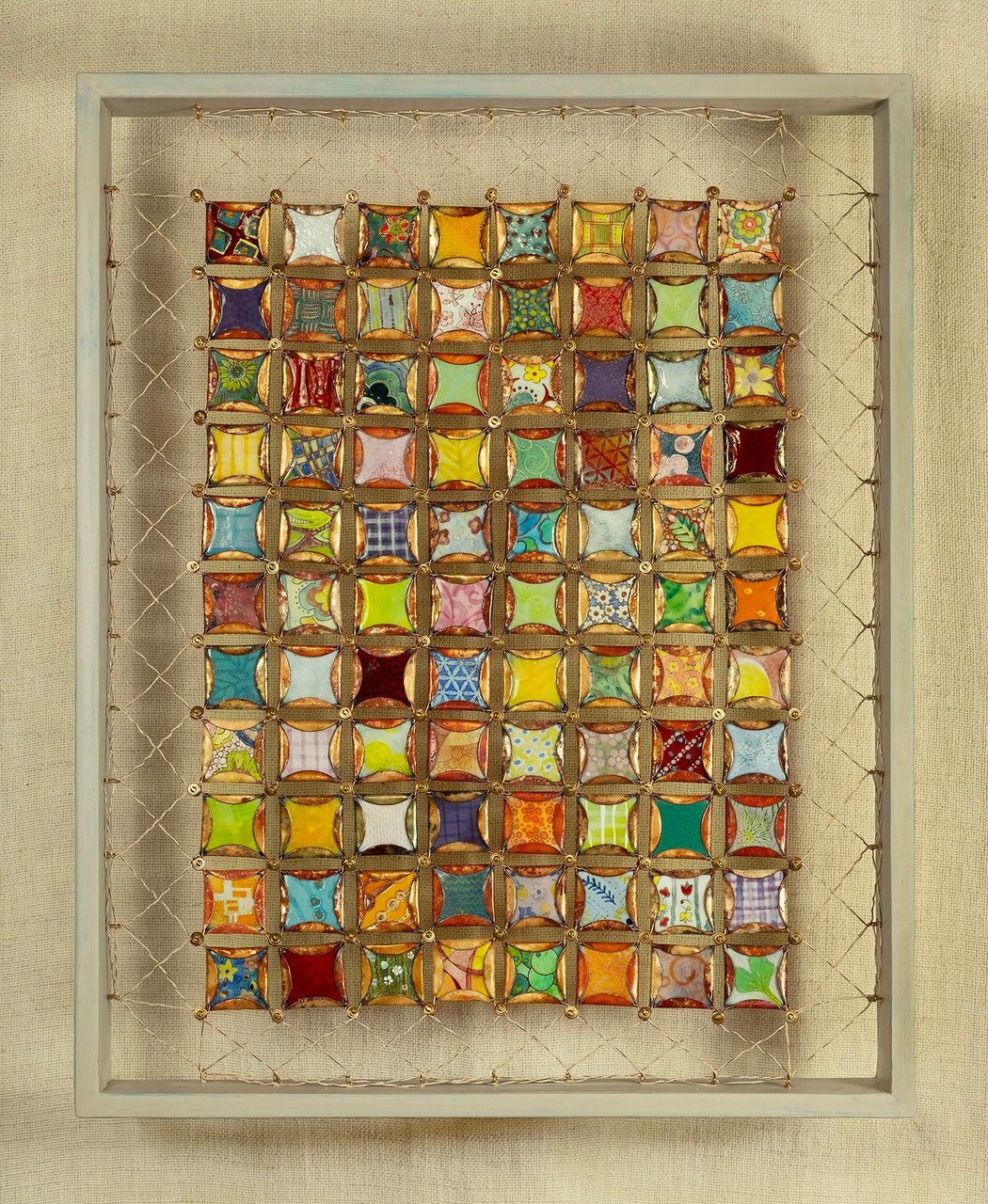
Mildred’s Cathedral Window by Cathy Vaughn
Wall Piece
Enameled copper
88 individual quilt squares using sgraffito with mason stains, graphite over etched enamel, fold formed + punched borax quenched discs, wire stitching
24 x 30 inches
Since 2007, Vaughn has found her voice working with copper. Beginning with structural creations of gates, tables and trellises, her work evolved next into large scale leaf portraits and smaller totem collages using harvested tree leaves and repurposed trash to render patinated images on copper. Early in the pandemic, she began exploring enameling through online course work, and later through experimentation and in-person classes. She now integrates enamel with patina through collage into her compositions on copper.
Vaughn exhibits at juried fine craft shows in the mid-Atlantic region throughout the year, and her work has been selected for juried gallery shows and many corporate and private commissions. Nine works are featured this year as part of a group show highlighting fine contemporary craft artisans from Virginia at the Charles H. Taylor Visual Arts Center in Hampton, VA.
Driven by a passion to honor and reinterpret the traditional textile craft of quilting, as taught by the strong women in her family of origin, Vaughn’s 2026 winter residency at the Pocosin Arts School of Fine Craft explored her idea to make a quilt from copper. Inspired by a cathedral window quilt made by her maternal grandmother, she returned home and began her first copper quilt composed of 88 individually fired quilt squares, completed this March.
The structure of a quilt, as defined by Merriam-Webster, requires three layers: a top layer, a layer of batting, and a backing, all held together with decorative stitching (known as quilting). In the land of enameling, Vaughn's interpretation has the top layer as the individually-fired decorative enamel squares; the batting as the counter enamel, which binds with the backing when fired; the backing as a copper disc annealed and quenched in borax to evoke tea-stained cloth. Each backing disc is "stitched" by hammering in a stitch pattern using a leather stitching tool, which facilitates folding the edges over the top layer and gives dimension to the reverse side of the quilt. A length of copper wire is layered in before folding and the final firing to give a mechanism for "stitching" each square together. Lastly, the quilt is suspended from a wooden frame with wire wrapped hemp cording, threaded through brass hooks. The path of the hooks is intentionally undulating to evoke a feeling of fabric; the cording follows a stitching pattern found in the edging of the original quilt. Care was given in firing to echo the antique nature of many of the fabric patterns used in the 46-year-old original quilt; sgraffito, combined with mason stains, lends itself to an antique feel.
Her primary focus in working with copper has shifted to enameling, as she continues to find inspiration from the natural world, the tradition of fine craft, and a desire to make playful and imaginative works that spark interest and reflect wonder.